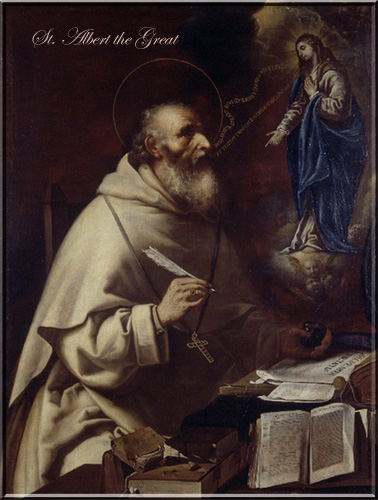
 St. Albert the Great,
 Doctor of the Church from Saint Albert le Grand, 1942
Saint Albert the Great was born in the region of Ausgbourg, of parents rich in the goods of fortune. From the time he was a child, he manifested in his studies an unusual aptitude for the exact sciences. While he was still a boy, he had himself let down the side of a cliff to examine at close range an eagle's nest which interested him. At the age of fifteen he was already a student of the natural sciences and the humanities at Bologna; Saint Dominic had died in that city the preceding year, 1221, and was buried in the Dominican Convent. Their house, in a suburban area of Bologna, was closely associated with the activities at the University, and students in large numbers were requesting admission to the Order.
Blessed Reginald of Orleans, Dominican, a former professor in Paris, came to preach there in the streets. The second Dominican General, Blessed Jordan of Saxony, a compatriot of Albert and a very eloquent preacher, was in Padua, and when the students of Bologna were transferred there Albert heard him at the Padua Dominican Church. He had already desired to enter the Order, but his uncle opposed to that plan a very vigorous opposition, and Albert was still very young. He dreamed one night that he had become a Dominican but left the Order soon afterwards. The same day he heard Master Jordan preach, and the Dominican General spoke of how the demon attempts to turn aside those who want to enter into religion, knowing that he will suffer great losses from their career in the Church; he persuades them in dreams that they will leave it, or else they see themselves on horseback, or clothed in purple, or as solitaries in the desert, or surrounded by cordial friends; thus he makes them fear entering because they would not be able to persevere. This was precisely Albert's great concern, faced as he was with his uncle's opposition. Afterwards the young student, amazed, went to Blessed Jordan, saying: "Master, who revealed my heart to you?" And he lost no time then in entering the Order at the age of sixteen, in 1223, having heard the same preacher remark to him personally that he should consider what a pity it would be if his excellent youthful qualities became the prey of eternal fires. When he had earned the title of Doctor in theology, he was sent to Cologne, where for a long time his reputation attracted many illustrious disciples. The humble Albert, filled with the love of God, taught also in Padua and Bologna, in Saxony, at Fribourg, Ratisbonne and Strasbourg, and when Blessed Jordan of Saxony died in 1237, he occupied his place and fulfilled his functions until 1238, when the election of his successor was held. He returned then to Cologne, where he would encounter a disciple who alone among all of them would suffice for his glory -- Saint Thomas Aquinas. This young religious, already steeped in the highest theological studies, was silent among the others, to the point of being called by his fellow students "the Mute Ox of Sicily." But Albert silenced them, saying, "The bellowings of this ox will resound throughout the entire world." From Cologne, Saint Albert was called to the University of Paris, with his dear disciple. There his genius appeared in all its brilliance, and there he composed a large number of his writings. Later, obedience took him back to Germany as Provincial of his Order. Without a murmur, he said farewell to his cell, his books, and his numerous disciples, and as Provincial thereafter journeyed with no money, always on foot, visiting the numerous monasteries under his jurisdiction, throughout an immense territory in which were included Austria, Bavaria, Saxony, and other regions even to Holland. He was no longer young when he had to submit to the formal order of the Pope and accept, in difficult circumstances, the episcopal see of Ratisbonne; there his indefatigable zeal was rewarded only by harsh trials, in the midst of which his virtue was perfected. When, in response to his persevering requests to be relieved of the responsibilities of a large see, Pope Urban IV restored to him the conventual peace of his Order, he was nonetheless obliged to take up his apostolic journeyings again. Finally he could enter into a definitive retreat, to prepare for death. One is astonished that amid so many labors, journeys and works of zeal, Albert could find the time to write on the natural sciences, on philosophy and theology, works which form from twenty-one to thirty-eight volumes, depending on the edition -- and one may ask in which of his titles he most excelled, that of scholar, of Saint, or of Apostle. He died, apparently of fatigue, at the age of seventy-three, on November 15, 1280, and his body was buried in Cologne in the Dominican church. He had to wait until December 16, 1931 for the honors of canonization and the extension of his cult to the universal Church. Proclaiming his holiness, Pope Pius XI added the glorious title, so well merited, of Doctor of the Church. From time immemorial, he has been known as Albert the Great. _____________________ Litany of St. Albert the Great
Lord, have mercy on us!
Christ, have mercy on us! Lord, have mercy on us! Christ hear us! Christ, graciously hear us! God, the Father of Heaven, Have mercy on us! God, the Son, Redeemer of the world, Have mercy on us! God, the Holy Ghost, Have mercy on us! Holy Trinity, one God, Have mercy on us! Holy Mary, Pray for us.* Holy Mother of God,* Holy Virgin of virgins,* Saint Albert,* Man after the heart of God,* Zealous client of Mary,* Worthy son of Saint Dominic,* Mighty defender of the Faith,* Solid rock of hope,* Burning Seraph of love,* Enlightened Cherub of wisdom,* Valiant defender of justice,* Sure norm of prudence, * Bright mirror of temperance, * Unshakable pillar of fortitude, * Living model of humility,* Shining example of poverty,* Pure lily of chastity,* True model of obedience,* Precious vessel of all virtues,* Zealous imitator of the Apostles,* Bright gem of Bishops,* Singular ornament of Doctors,* Special glory of thy Order,* Golden treasure of thy Fatherland,* Certain protector of thy clients,* Albert the Great,* In anguish and in need,* In tribulation and in persecution,* In the hour of death,* Lamb of God, Who takest away the sins of the world: Spare us, O God! Lamb of God, Who takest away the sins of the world: Hear us, O Lord! Lamb of God, Who takest away the sins of the world: Have mercy on us, O Lord! Christ, have mercy on us! Lord, have mercy on us! V. Pray for us, Saint Albert: R. That we may be made worthy of the promises of Christ. Let us pray. O God, Who didst richly adorn Saint Albert with Thy heavenly gifts and didst decorate him with all virtues: grant us, Thy servants, that we may follow in his footsteps, may persevere in Thy service until death and securely obtain an everlasting reward. Through Jesus Christ, Thy Son, Our Lord. R. Amen _____________________ Prayer Composed by St. Albert the Great
Be Thou Blessed, O Humanity of my Saviour, Which was united to the Divinity in the womb of a Virgin Mother! Be Thou Blessed, O sublime and eternal Divinity, Who wast pleased to come down to us under the veil of our flesh! Be Thou for ever Blessed Who, by the power of the Holy Ghost, didst unite Thyself to virginal flesh! I salute you also, O Mary, in whom the fulness of the Divinity dwelt! I salute you in whom the fulness of the Holy Ghost dwelt! May the most pure Humanity of the Son be equally Blessed, Which, consecrated by the Father, was born of you! I salute thee, O unspotted virginity, now raised above all the choirs of Angels. Rejoice, O Queen of Heaven, who didst merit to become the temple of the spotless Humanity of Christ! Rejoice, and be glad, O Virgin of virgins, whose pure flesh united the Divinity with the Sacred Humanity! Rejoice, and be glad, O Spouse of the holy Patriarchs, who wast deemed worthy to nourish and suckle at thy breast the Sacred Humanity. I salute thee, ever blessed and fruitful virginity, which didst merit to obtain the fruit of life and the joys of eternal salvation. Amen.
_____________________ Sermon of St. Albert the Great on the Feast of All Saints
After portraying their beatitude, St. Albert explains this passage of the Apocalypse: "The Lamb which is in the midst of the Throne shall rule them, and shall lead them to the fountains of the waters of life" (vii. 17).
"In God's kingdom, there are five fountains, to which the Lamb will lead His elect. The first is the source of consolation; there the Lord shall wipe away their tears. The second is the fountain of repose; for after having dried up their tears, the Spirit, that is the Holy Trinity, will say: 'Henceforth they shall rest from their labours.' The third is the source of refreshment; for they who are at rest shall be refreshed and inebriated with the superabundance of God's house. The fourth is the source of joy. The elect, by reason of the heavenly consolations, the sweets of repose and the most agreeable refreshment, shall be in jubilation. They shall sing their salutations with gladness in the courts of the predestined. The fifth is the fountain of love. How ardently will they not love Him, Who consoles them, Who gives them rest and loads them with every good? Isaias, speaking of this fountain, says: 'You shall draw water with joy from the fountain of the Lord.'"
"On the other hand, in hell there are, five fountains, to which the infernal dragon thrusts the souls of the reprobate, that they may drink thereof. The first is called Styx. When souls drink of those waters, they conceive a mutual hatred of each other. The second is named Phlegethon. The property of its waters is to enkindle the rage of the damned, first against themselves, then against those through whose fault they are lost. The name of the third is Lethe: scarcely have the reprobate tasted of it than they lose the knowledge and recollection of past joys and pleasures. The fourth is Acheron. The damned on applying their lips to it immediately sink into indescribable sadness. The fifth bears the name of Gocytus. The effects of those waters are such that they who drink of them weep without ever experiencing the least consolation."
Common of Doctors
R. Well done, good and faithful servant, because thou hast been faithful over a few things I will place thee over many things: Enter thou into the joy of the Lord.
V. Lord, thou didst deliver to me five talents: behold I have gained other five talents. Enter thou into the joy of the Lord. R. Behold a great priest, who in his days pleased God: Therefore by an oath the Lord made him increase among his people. V. He gave him the blessing of all nations, and confirmed his covenant upon his head. Therefore by an oath the Lord made him increase among his people. R. The Lord hath sworn, and will not repent: Thou art a priest forever according to the order of Melchisedech. V. The Lord said unto my Lord, sit thou at my right hand. Thou art a priest forever according to the order of Melchisedech.
http://catholicharboroffaithandmorals.com/ |